Software & Resources
We develop and maintain open-source software for time-series analysis, from large feature-extraction toolkits to compact canonical feature sets, new analysis methods, and benchmark datasets.
Everything is on our GitHub organization, where you will also find code for reproducing the results in our papers, and documented in detail in our time-series analysis tools guide.
Feature-extraction toolkits
Highly comparative toolkits that compute thousands of time-series features, or hundreds of pairwise interaction statistics, so that the best-performing methods for a problem can be found and interpreted systematically.
hctsa
MATLAB
Extract thousands of time-series analysis features from a collection of time series.

pyhctsa
Python
The Python successor to hctsa, and the most comprehensive time-series feature extraction package in Python. The active development path.

pyspi
Python
A comprehensive library for computing pairwise interactions from multivariate time series.

theft
R
Extraction, analysis, and visualisation of a range of open time-series features.
Canonical feature sets
Small, fast, interpretable sets of features distilled from the full hctsa library, for when you want strong performance without the computational cost.

catch22
CMATLABPythonRJulia
Evaluate 22 high-performing time-series features, coded efficiently in C and wrapped for python, with native versions for R and Julia.
catchaMouse16
CMATLABPython
Sixteen time-series features selected to characterise biologically informative dynamical patterns in mouse fMRI.
Methods
Implementations of new time-series analysis methods developed in the group.
See also our feature-based information-theoretic method for detecting interpretable, long-timescale pairwise interactions.
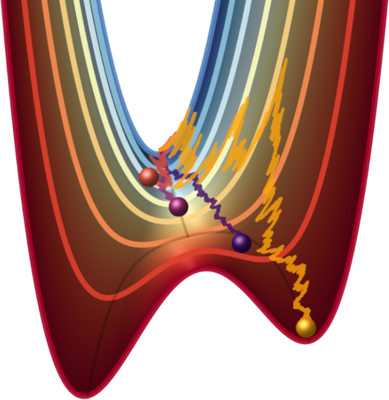
RAD
PythonMATLAB
Rescaled Auto-Density, a noise-robust way to track the distance to criticality from time-series data.
MPSTime
Julia
Quantum-inspired time-series machine learning, modelling the joint distribution with matrix-product states.
tsdr
Python
Python implementations of time-series dimension reduction methods from seven algorithm categories.
Datasets
Curated collections of time series with ground truth, for benchmarking and teaching.

1000x1000
Python
The 1000×1000 collection; 1000 simulated time series from 133 dynamical processes, each with ground truth, as a companion to Empirical1000.
Resources
Guides and documentation we maintain for our tools, and for doing research more generally.
Time-series analysis tools guide
Documentation hub for all of our software, with installation guides, tutorials and the papers behind each tool.
catch22 feature documentation
What each of the 22 catch22 features measures, with worked examples.
Research resources
Our advice for researchers, including doing a PhD, scientific writing, making figures, coding and computation, reproducible science, and organising your time.
Pathways to a PhD in our group
How to join the group as a research student, from first contact to scholarship applications.
Visiting or moving to Sydney
Practical notes for visitors and new arrivals.
Our GitHub organization
All of our software repositories, plus code and data for reproducing the results in our papers.
Our software is free for non-commercial use.
For commercial licensing, or help applying these tools to your own data, see Engine Analytics.
 Dynamics and Neural Systems Group